Technical Codex
I. The Rendering Engine
Every SACRED piece is constructed from individual stipple marks — single points of colour placed with floating-point precision on an 800×800 canvas. No gradients, no fills, no blend tricks. Every hue you perceive is the optical result of thousands of discrete ink marks overlapping at subpixel resolution.
The engine draws two primitive types: ink circles (100 concentric rings of stipples spiralling outward from a centre point) and ink rings (a single stipple ring at a given radius). Every geometry in the collection is composed entirely from these two primitives.
Rendering is chunked — each circle or ring cluster is processed as an independent task, yielding to the browser between tasks so the interface remains responsive. A typical piece takes 12–45 render tasks depending on the geometry, with each task placing tens of thousands of stipples before yielding.
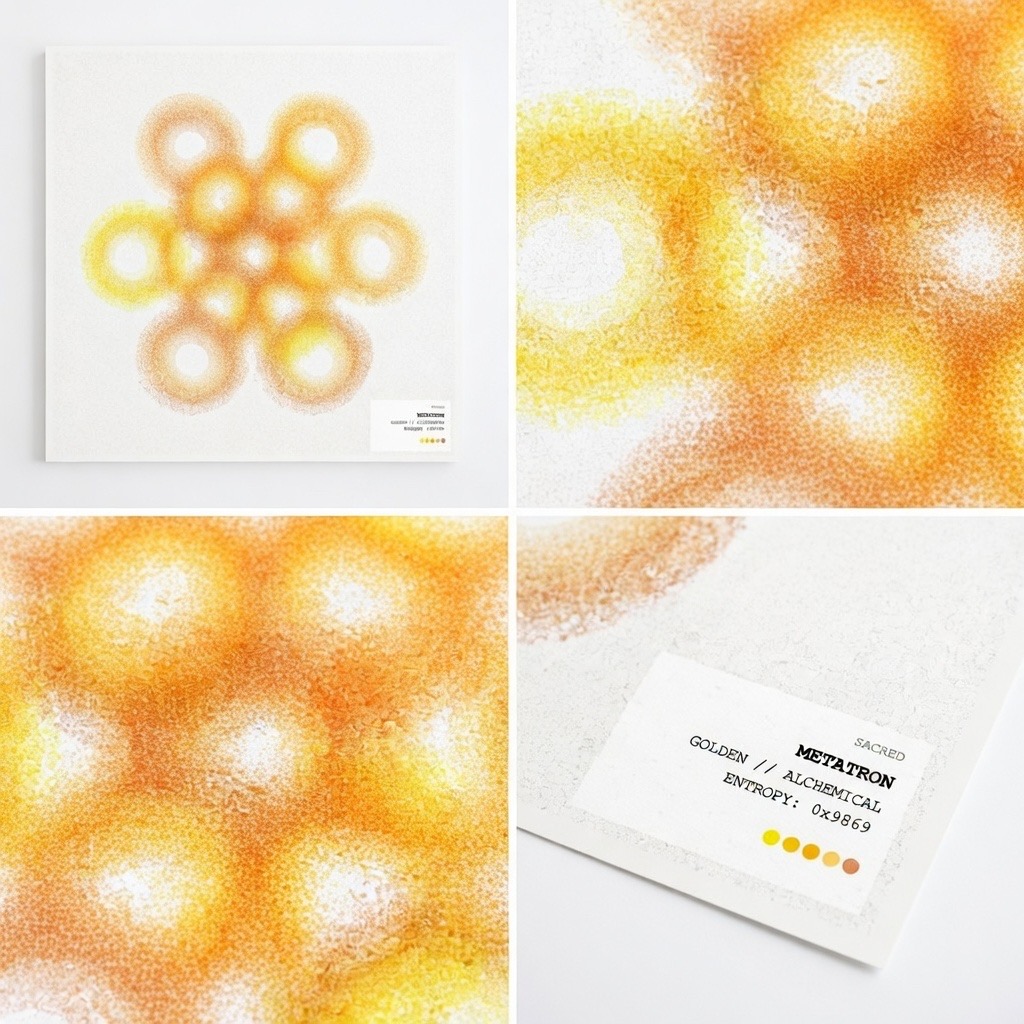
The MULTIPLY blend mode means colours mix subtractively, as pigments do on paper. Where a blue stipple circle overlaps a yellow one, you see green — not through computation, but through the same optical physics that governs watercolour and lithographic printing. This is pointillism in the tradition of Seurat and Signac, executed at computational scale.
II. The Seven Sacred Geometries
Your vocal frequency — captured as a 5-second weighted average during the voice ritual — determines which geometry manifests. The frequency spectrum is divided into seven bands, each mapped to a geometry — from the foundational Seed of Life at the lowest register to the counter-rotating Merkabah at the highest. The voice does not reach for a form. It arrives at one.
| Geometry | Hz Range | Construction | Stipples |
|---|---|---|---|
| Seed | 80 – 107 | 7 overlapping ink circles | 840,000 |
| Metatron | 107 – 143 | 13 node circles + connecting ring edges | 655,200 |
| Vesica | 143 – 191 | 6 ink circles in paired overlap | 1,440,000 |
| Flower | 191 – 256 | 19 ink circles in hexagonal bloom | 1,680,000 |
| Torus | 256 – 342 | 12 concentric ring spirals | 1,440,000 |
| Equilibrium | 342 – 457 | 12 ink circles (4 inner + 8 outer ring) with bridge spray | 1,484,000 |
| Merkabah | 457 – 600 | 6 spiralling ring paths | 756,000 |
The Hz ranges above are rounded to whole numbers. The engine operates on the continuous logarithmic curve — boundaries are computed as floating-point thresholds, not integer values.
Every geometry is built exclusively from circles and rings — the fundamental language of sacred geometry. There are no straight lines, no angular fills, no polygon rendering. The forms emerge from the overlapping relationships between curved elements, just as they do in classical sacred geometric construction with compass and straightedge.
Equilibrium is derived from the cubeoctahedron — a form Buckminster Fuller called the "Vector Equilibrium" because it is the only polyhedron in which every edge length equals the radial distance from centre to vertex. Fuller considered it the zero-phase geometry from which all other forms emerge. Our rendering projects its 12 vertices as concentric ink circle clusters arranged in an inner ring of 4 and an outer ring of 8, connected by a fine bridge spray of stipples that preserves the relationship between the two orbits without collapsing their colour fields.
The Merkabah is the star tetrahedron — two interlocking tetrahedra, one pointing upward, one downward, rotating in opposite directions. In three dimensions it is a solid of counter-rotation; in SACRED's two-dimensional rendering, each tetrahedron is projected as three spiralling ring paths, giving six paths in total. The spiral motion preserves the sense of rotation that defines the form — static geometry made kinetic through the stipple field.
III. The Colour System
The colour field emerges independently of the voice frequency — a separate dimension of the transmission. Where your voice determines the geometry, the palette is bestowed by the field at the moment of materialisation. No two transmissions receive the same palette in the same order, even within the same geometry. Colour and form arrive together, seeded by the mathematics of the moment.
Perceptual Colour Space
All colour generation operates in the OKLCH perceptual colour space (Oklab Lightness-Chroma-Hue), defined in the CSS Color Level 4 specification. Unlike HSL or RGB, OKLCH ensures that equal numerical steps in hue produce equal perceptual steps in colour — a 20° hue shift looks the same magnitude regardless of where on the colour wheel it occurs. This means our harmonic schemes produce genuinely balanced palettes, not the lopsided results that plague HSL-based generation.
The conversion pipeline runs: sRGB → Linear RGB → CIE XYZ → OKLab → OKLCH, with the reverse pipeline for rendering. All intermediate calculations use floating-point precision.
Palette Character — Full Reference
Ten palette types across three families. Each carries a different tonal quality — from monochromatic restraint to full-spectrum colour. The three Alchemical palettes and the Fortune palette are fixed and assigned by the field. The six Spectrum schemes are generated mathematically from the OKLCH colour space, each with its own harmonic logic.
Every palette is shuffled after generation. Because colour assignment to geometric elements is position-dependent, the same set of colours in a different order produces a visually distinct piece. This shuffle multiplier — applied to every scheme — is a significant driver of collection diversity.
IV. Combinatorial Uniqueness
A common question: with 7,777 pieces, can they really all be unique? The answer involves three layers of variation, each multiplying the others.
Layer 1: Discrete Palette Combinations
Layer 2: Geometry × Palette
Each of the 16,926 palettes can manifest across any of the 7 sacred geometries.
With 7,777 pieces drawn from 118,482 possible combinations, the probability of any two pieces sharing the same geometry and exact palette (including colour order) is vanishingly small.
Layer 3: Floating-Point Entropy
Even if two pieces shared the same geometry and identical palette, they would still be visually unique. Every stipple mark is placed using JavaScript's floating-point entropy — a unique coordinate for every point, unrepeatable by mathematical certainty. With up to 1.68 million stipples per piece, the probability of two pieces producing the same stipple pattern is effectively zero — on the order of 1 in 105,000,000.
This is a mathematical consequence of the rendering architecture. JavaScript's pseudo-random number generator produces sufficient entropy that two independent renderings — even with identical geometry and palette — will never produce the same stipple configuration. Every SACRED transmission occupies a unique point in a space so vast it defies meaningful comparison.
V. Voice Mechanism
The voice capture system records 5 seconds of audio via the Web Audio API, computing a real-time FFT (Fast Fourier Transform) to extract the dominant frequency. The system uses a weighted averaging algorithm that prioritises the sustained fundamental over transient harmonics, producing a stable Hz value that represents the speaker's natural vocal resonance in that moment. The weighting follows a sinusoidal bell curve across the 5-second window — samples at the midpoint carry maximum weight, while the first and last moments of the capture are suppressed. This discounts breath onset, initial pitch instability, and trailing off, isolating the sustained core of the hum.
Frequency-to-geometry mapping uses a logarithmic scale, not linear. Musical intervals are logarithmic by nature — a jump from 100 Hz to 200 Hz (one octave) is perceptually equal to 200 Hz to 400 Hz (one octave). A linear mapping would cluster most human voices (which sit between 80–300 Hz) into just 2–3 geometries, leaving the higher forms practically unreachable. The logarithmic mapping divides the vocal range (80–600 Hz) into 7 perceptually equal zones, ensuring all seven geometries are achievable across the natural range of human vocal production.
When the vocal range was divided into seven equal logarithmic zones — a practical decision to give all geometries equal probability across human pitch perception — the mathematics produced something unexpected. The step ratio between each zone boundary is 1.3335, within 0.015% of 4/3: the just perfect fourth, one of three intervals Pythagoras considered fundamental to the structure of the cosmos. Each boundary is separated by 498.3 cents. A pure perfect fourth is 498 cents. The difference is 0.3 cents — inaudible. The seven geometries of SACRED are separated by Pythagorean consonances. Nobody put them there.
Lower voices (80–143 Hz, typical male speaking range) produce Seed or Metatron. Mid-range voices (143–342 Hz, spanning high male to female speaking range) produce Vesica, Flower, or Torus. Higher frequencies (342–600 Hz, upper register and falsetto) produce Equilibrium or Merkabah. The same person humming at different pitches on different days will produce different geometries. The system does not simulate or approximate; it measures and maps.
For those who prefer not to use their voice, the Entropy path generates geometry through computational entropy, using the system's floating-point randomness as a frequency proxy. Every piece produced through this path carries an entropy hash in place of a Hz value.
The voice does not merely select a shape. It initiates a cascade. The geometry determines the stipple architecture — how many circles, how many rings, how many hundred thousand marks. The palette, bestowed at the moment of transmission, determines how those marks blend optically. The entropy of the rendering determines where each mark falls. Every layer is distinct. Every layer is unreproducible. The voice is the first domino.
VI. High-Resolution Export
Sealed pieces are rendered at 6144×6144 pixels via a dedicated high-resolution buffer that re-executes the entire geometry pipeline at print scale. The high-resolution render uses identical parameters to the screen version — same stipple counts, same colour values, same geometric positions — scaled proportionally to ensure the print is a faithful enlargement, not a reinterpretation.
VII. The Archive Label
Every sealed print carries an archive label rendered directly into the artwork — not a sticker, not a separate certificate, but part of the image itself. The label sits in the lower border of the print and contains:
Geometry name — Palette family // Scheme name
Frequency in Hz (or Entropy hash for entropy-path pieces)
Palette dots — the Colour DNA of the piece: the exact colours from which every mark was drawn. The number of dots reflects the colours present in that specific transmission.
The label is baked into the high-resolution render at print time. It cannot be removed, altered, or forged without destroying the stipple field around it. No certificate of authenticity is needed. The art authenticates itself.